Germanium Market: Powering the Future of Semiconductors, Fiber Optics, and Clean Energy
- Feb 23
- 6 min read
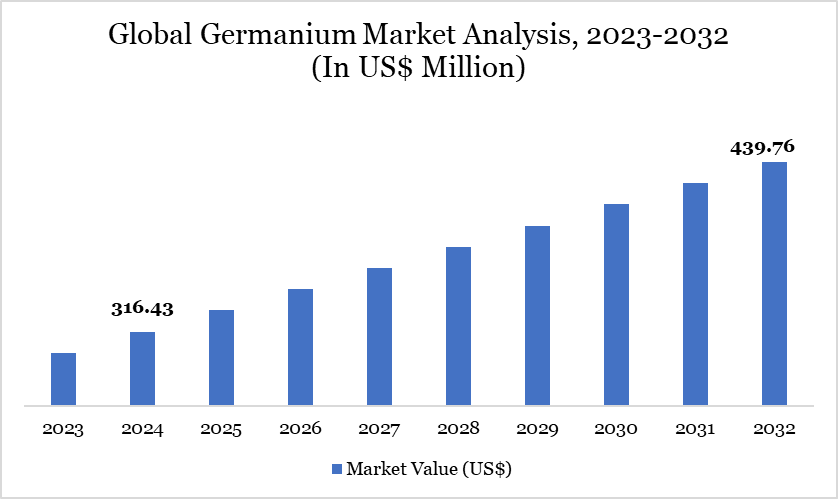
According to DataM Intelligence, the Global Germanium Market reached approximately USD 316.43 million in 2024 and is projected to grow to around USD 439.76 million by 2032, expanding at a CAGR of 4.20% from 2025 to 2032. This growth reflects the rising strategic importance of germanium as a critical material in advanced technologies. As demand accelerates across fiber optics, infrared optics, semiconductors, and high-efficiency solar applications, germanium is increasingly being recognized as a key enabler of next-generation telecommunications, defense systems, and renewable energy infrastructure. Its unique semiconductor and optical properties make it indispensable for high-performance and precision-driven industries.
By 2032, germanium will not be viewed merely as a niche rare metal. It will be positioned as a strategic critical mineral embedded within global semiconductor supply chains, optical technologies, and clean energy ecosystems, driven by expanding investments in high-tech manufacturing and the global transition toward digital and energy-efficient technologies.
Why Germanium Market Is Gaining Strategic Importance The rapid expansion of the germanium market is driven by three structural shifts in global technology, energy, and semiconductor ecosystems.
•Strategic demand from advanced electronics and semiconductors is rising. Germanium is a critical material in fiber optics, infrared optics, and high-performance semiconductors used in defense, telecommunications, and space applications. As next-generation technologies such as 5G, AI hardware, and photonics scale, the reliance on germanium-based components is increasing significantly.
•Supply chain concentration and resource scarcity are reshaping procurement strategies. Germanium production is largely a byproduct of zinc refining and is geographically concentrated, creating supply vulnerabilities. Governments and manufacturers are prioritizing secure sourcing, recycling, and stockpiling of critical minerals like germanium to mitigate geopolitical and trade risks.
•Growth in renewable energy and infrared technologies is accelerating adoption. Germanium is widely used in high-efficiency solar cells, particularly for satellites and concentrated photovoltaic systems, as well as in thermal imaging and defense optics. Expanding investments in clean energy, aerospace, and surveillance technologies are strengthening long-term demand fundamentals.
Together, these factors are pushing germanium from a niche specialty material into a strategically critical resource within global semiconductor, defense, and energy market roadmaps.
Request Executive Sample | Market Intelligence: https://www.datamintelligence.com/download-sample/germanium-market?sindhuri
Market Segmentation Analysis – Germanium Market
By Type
Germanium Ingot accounted for approximately 38% of global market value in 2024, equivalent to around USD 0.95 billion. Germanium ingots are widely used in infrared optics, semiconductor substrates, and space-grade solar cells due to their high crystal purity and superior optical properties. Demand is particularly strong from aerospace and defense applications.
Germanium Tetrachloride represents approximately 27%, or USD 0.67 billion. This segment is primarily driven by its use in fiber optic cable manufacturing, where it enhances refractive index and transmission efficiency. Expanding 5G infrastructure and broadband connectivity projects are supporting steady demand growth.
High Purity GeO2 accounts for roughly 23%, or USD 0.58 billion. High-purity germanium dioxide is essential in PET polymerization catalysts and specialty glass applications. Increasing PET packaging consumption and optical glass manufacturing are contributing to segment expansion.
Other forms of germanium hold the remaining 12%, or approximately USD 0.30 billion. These include germanium metal powder and specialty compounds used in research, electronics, and niche industrial applications.
From a strategic perspective, germanium ingots and tetrachloride will continue to dominate due to strong demand from defense, fiber optics, and renewable energy sectors.
By Application
Fiber Optics leads the market with approximately 34% share, or USD 0.85 billion in 2024. Germanium tetrachloride is a critical dopant in optical fibers, and global data traffic growth is sustaining long-term demand.
Electronics & Solar accounts for around 26%, or USD 0.65 billion. Germanium substrates are widely used in high-efficiency multi-junction solar cells, particularly in space applications, as well as in semiconductor devices.
IR Optics represents approximately 21%, or USD 0.52 billion. Germanium’s transparency in the infrared spectrum makes it essential for thermal imaging systems, surveillance equipment, and military-grade optics.
PET applications contribute about 14%, or USD 0.35 billion. Germanium dioxide is used as a catalyst in PET resin production, particularly in high-clarity and specialty packaging.
Other applications account for the remaining 5%, or USD 0.13 billion. These include metallurgy, phosphors, and emerging research applications.
According to market analysis, fiber optics and electronics & solar applications will remain key growth drivers through 2030, supported by digital infrastructure expansion and renewable energy investments.
By Region
Asia Pacific dominates the global market, accounting for approximately 46% of total revenue, or USD 1.15 billion in 2024. The region benefits from strong electronics manufacturing, fiber optic production, and solar panel supply chains, particularly in countries such as China, Japan, and South Korea.
North America represents around 24%, or USD 0.60 billion. Demand is driven by aerospace & defense applications, advanced semiconductor manufacturing, and space-based solar technologies.
Europe accounts for approximately 18%, or USD 0.45 billion. The region’s focus on renewable energy, automotive sensors, and industrial optics supports steady consumption.
South America holds about 6%, or USD 0.15 billion. Growth is moderate, primarily linked to telecommunications infrastructure development.
The Middle East and Africa represent roughly 6%, or USD 0.15 billion. Rising investments in telecom infrastructure and defense technologies are contributing to gradual market expansion.
From a regional perspective, Asia Pacific will continue to lead production and consumption, while North America and Europe remain strategically important due to advanced defense, aerospace, and semiconductor demand.
Regional Fastest China China dominates the global germanium market, accounting for over 60% of global production and refining capacity, with market value estimated at around USD 210 million in 2024. This dominance is driven by: •Control over germanium refining and by-product extraction from zinc ores •Strong domestic demand from fiber optics and electronics sectors •Government export policies and strategic mineral prioritization •Integrated semiconductor and solar manufacturing ecosystem By 2030, China’s germanium market is expected to expand significantly, supported by growing demand in infrared optics, defense systems, and advanced electronics.
Germany Market Growth & Forecast •The Germany germanium market is expanding steadily as demand rises from high-tech manufacturing, photonics, and semiconductor applications. Industry forecasts indicate strong growth through the late 2020s, supported by Europe’s focus on strategic raw material security and advanced technology production. •Global germanium demand is projected to grow at a robust CAGR, with Germany benefiting as a key industrial hub in the European supply chain, particularly in optics, automotive sensors, and renewable energy technologies.
Policy & Government Initiatives •Germany and the broader European Union are strengthening supply-chain resilience for critical raw materials, including germanium, under strategic autonomy and critical minerals policies. •Increased regulatory focus on recycling, sustainable sourcing, and circular economy initiatives is encouraging investment in germanium recovery from industrial by-products and electronic waste.
Deployment Trends & Technology Adoption •Manufacturers in Germany are increasingly using germanium in infrared optics, fiber-optic systems, and semiconductor substrates due to its superior optical and electrical properties. •Hybrid applications combining germanium with silicon in advanced chips and photonics are gaining traction, particularly in AI hardware, telecommunications, and aerospace technologies.
Market Drivers & Industrial Demand •Surging demand for fiber optics, 5G infrastructure, and thermal imaging systems is a major growth catalyst for germanium consumption. •Expansion in electric vehicles, satellite technologies, and defense electronics is further accelerating adoption, as germanium enables high-efficiency sensors and solar cells used in space applications.
Competitive Landscape The germanium market is characterized by a mix of mining companies, material refiners, and advanced materials manufacturers integrating germanium into high-value applications. Teck Resources Limited is a key supplier of germanium as a by-product of zinc refining. Umicore plays a significant role in germanium recycling and advanced materials processing. Yunnan Germanium Co., Ltd. is a major global producer specializing in high-purity germanium products. JSC Germanium focuses on germanium-based optical and electronic materials. American Elements supplies germanium for semiconductor, optical, and research applications. Specialist innovators and photonics manufacturers continue to strengthen the ecosystem through advancements in infrared optics, solar cells, and semiconductor-grade germanium. From a competitive standpoint, refining purity, recycling capability, and integration into high-tech applications will define market leadership through 2030.
What Will Define the Germanium Market by 2030
By 2030, the germanium market is projected to witness strong strategic growth, driven by:
•Expansion of semiconductor and advanced chip manufacturing •Rising demand for fiber-optic communication infrastructure •Growth in infrared optics for defense and aerospace applications •Increasing adoption in solar cells, particularly for space applications
According to DataM Intelligence analysis:
•Semiconductor-grade germanium will dominate product demand •Fiber-optic and infrared optics applications will lead consumption •Asia-Pacific will remain the largest production and consumption hub •Supply security and recycling initiatives will shape trade dynamics
By 2030, germanium will be viewed as a critical strategic material, not just a specialty metal, due to its importance in next-generation electronics, defense systems, and high-performance communication networks.
Executive Takeaway
For policymakers, manufacturers, and technology leaders, germanium represents a strategic material essential to digital infrastructure and advanced defense capabilities.
Organizations that succeed will be those that:
•Secure long-term supply through diversification and recycling •Invest in high-purity processing and refining capabilities •Align sourcing strategies with geopolitical risk management •Capitalize on demand growth from semiconductors and photonics
As global demand for advanced electronics and secure communication systems accelerates, germanium will play a defining role in the next generation of high-performance, technology-driven industrial development.


Comments